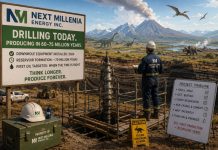















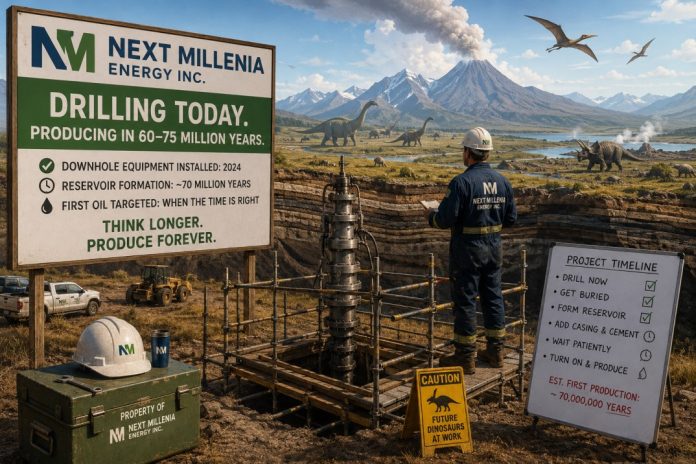
CALGARY, Alberta – While most oil and gas companies are focused on quarterly results, NextMA Energy Inc. (NME) has decided to think slightly further ahead by developing reservoirs that are expected to become commercially viable sometime around the next mass extinction event. NME (TSX-V: NMA) recently acquired surface rights across 87 townships in the Western Canadian Sedimentary Basin with plans to begin drilling wells that are expected to become economically viable sometime shortly after humanity evolves into glowing telepathic gas clouds.
Rather than chasing existing reservoirs, NME is taking a more proactive approach by installing downhole equipment now, then simply waiting 60 to 75 million years for tectonic activity, mountain formation, erosion, sediment deposition, burial, pressure, heat, hydrocarbon maturation, and reservoir trapping to do the rest.
“It’s really about getting ahead of the curve,” explained Hugh Jasperations while pointing enthusiastically at a PowerPoint slide labeled ‘Jurassic-ish Stuff Happens Here.’ “Most companies wait for reservoirs to exist before producing them. That’s outdated thinking. We believe the best way to find oil is to invent it ourselves through continental drift.”
According to company officials, modern AI modeling now allows NME to predict future orogeny, seismicity, depositional environments, subsidence patterns, and approximately where Saskatchewan will emotionally be in 70 million years.
The company says its proprietary software can already identify future structural closures with “moderate confidence,” provided Earth does not experience “unexpected asteroid-related setbacks.”
The process itself is surprisingly straightforward. Workers simply place downhole pumps, tubing, and completion equipment on scaffolding today, then future generations will gradually add casing and cement over several geological epochs until the reservoir naturally forms around the original equipment.
“At that point,” said one engineer, “you basically just turn the well on and pray the pump warranty is still valid.”
Industry insiders admit the concept is revolutionary, although some investors have reportedly expressed concerns over the project’s timeline.
“We did lose a few shareholders after they learned first cash flow was expected sometime during the rise of intelligent amphibian civilizations,” admitted Michael Moneygonne. “But those people lacked vision. We’re looking beyond quarterly earnings. We’re looking beyond humanity itself.”
Despite the unprecedented timeline, NME insists the economics remain attractive.
Initial capital costs are estimated between $25 million and $27.2 million, with ongoing infrastructure additions projected at just $250,000 per decade — assuming inflation, societal collapse, and molten lava incidents remain manageable.
The company is also working closely with local municipalities to ensure all exposed future wellheads remain aesthetically pleasing for nearby landowners over the next several extinction events.
“We’ve committed to tasteful earth-tone scaffolding,” said Jasperations. “We want the equipment to blend naturally into the environment while it waits beneath several kilometers of sedimentary rock.”
At press time, NME had reportedly begun preliminary discussions with lenders regarding a new 75-million-year fixed-rate mortgage.