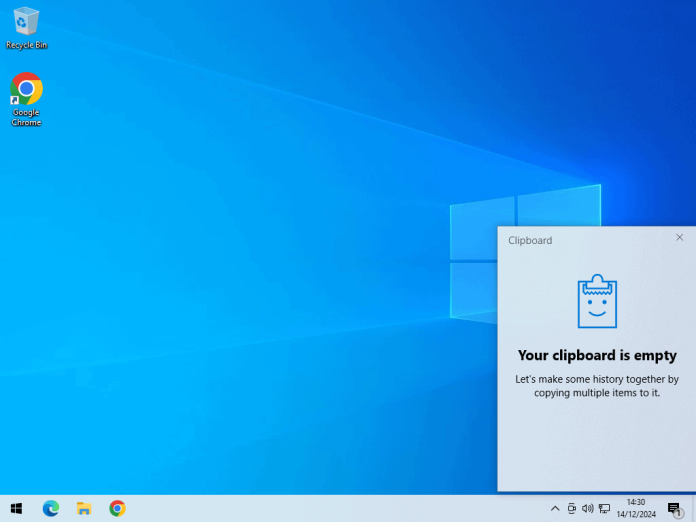
Have Swiss scientists finally figured out why items placed on the Excel clipboard appear disappear before you've had a chance to paste them?
GENEVA, Switzerland – In a groundbreaking study published this week in the Journal of Computational Nonsense, researchers at the Federal University of Klingnau’s department of Spreadsheet Physics have finally uncovered the reason why anything copied into Microsoft Excel’s clipboard vanishes after precisely 4.20 picoseconds.
According to lead scientist Dr. Kat Schrod, “The clipboard doesn’t actually delete your data — it merely ceases to exist within our observable universe. At that timescale, Excel transitions into a quantum mechanical superposition of ‘copied’ and ‘not copied.’”
Quantum Clipboard Collapse
At the core of this mystery lies what physicists call the Clipboard Uncertainty Principle, which states that the more precisely you know what you’ve copied, the less likely Excel will remember it.
When you hit Ctrl+C, you’re essentially creating a localized excitation in Excel’s RAM-space quantum field. This energy field momentarily stabilizes the copied object — a delicate lattice of 10 coupled, non-linear, partial differential equations — before quantum vacuum fluctuations annihilate it.
Dr. Schrod elaborates:
Dr. Kat Schrod, lead reseracher
“Excel’s clipboard exists in a metastable anyon-based quantum foam. The moment you even think about pressing Ctrl+V, decoherence occurs, and the copied object collapses into a null pointer faster than the IT guy can say, ‘Did you try rebooting?’”
Special Relativity and the Speed of Paste
Einstein’s Special Relativity further complicates matters. Because Excel operates in a four-dimensional Hausdorff differential manifold of rows, columns, sheets, and pure rage, time dilation effects occur between your copy and paste operations.
As you move your mouse toward a new cell, you’re effectively approaching light speed relative to the clipboard due to length contraction of the mouse cursor. This causes time to stretch and data coherence to shrink — meaning by the time your cursor arrives, the clipboard’s 4.20 picoseconds have long since expired in your non-inertial reference frame. “Technically,” says Dr. Tangent, “you’ve pasted something in the past. The spreadsheet just doesn’t know it yet.”
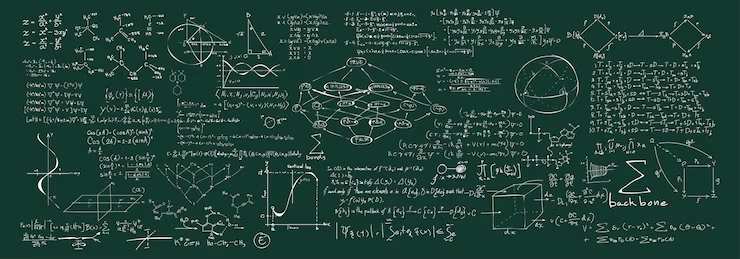
The theory behind the findings, scribbled on Dr. Schrod’s black board.
General Relativity: The Gravitational Sinkhole of Excel
The gravitational field generated by particularly large Excel files, for example, macro-heavy files exceeding 50 MB and containing 12 pivot tables nested inside each other, actually warps local spacetime.
This curvature creates a clipboard event horizon, from which no copied item can escape. Attempts to paste beyond this threshold simply produce a #REF! singularity, where time, space, and formulas are crushed into a single, eternal error message.
Quantum Field Theory: The Excel Boson
The team also discovered evidence of a previously unknown particle: the Excelion Boson, a carrier of the Paste Interaction Force.
This boson mediates the probability of a successful paste event — but its half-life, inconveniently, is 2.09 picoseconds. Once it decays, your copied cells are instantaneously replaced by whatever was last in your clipboard during the Obama administration.
The Excelion Boson interacts strongly with the Office 365 Higgs Field, giving mass to corporate frustration and producing measurable sighs from cubicles across the planet.
The Final Theory
Until a Grand Unified Theory of Copy-Paste Mechanics is achieved – one that harmonizes General Relativity, Quantum Field Theory, and VBA Macros – Excel’s clipboard behaviour will remain one of modern science’s greatest mysteries.
Dr. Schrod concluded her remarks with a simple plea to users everywhere. “If you value your data, just paste immediately. In Excel, hesitation isn’t just costly — it’s relativistically impossible.”
Researchers are now applying for a $6.3 million grant to explore whether items copied in Google Sheets persist longer than 7 femtoseconds. Early indications suggest no.
As always, 2P News readers from the oilpatch were quick to weigh in with their own scientific insights, deep philosophical reflections, and several beer-fueled Excel confessions. Below is a curated sample of the least coherent responses that still passed the spellcheck filter (barely):
FracDaddy420: 4.20 picoseconds? Nice. That’s still longer than my frac data stays organized before Excel “recalculates” my entire life.
MudloggerMike: Makes sense. Last time I copied core data from Sheet1 to Sheet2, it tunneled into another dimension and came back as the middle finger emoji.
ResEngRandy: If Excel’s clipboard obeys quantum laws, does that mean my PVT table is technically both copied and lost until I try to paste it? Because that tracks.
PetroPhil: I once tried copying an entire production report. The gravitational field it created pulled in three junior engineers and a coffee mug. Only the mug survived.
SurveySteve: This is why I only copy one cell at a time and whisper “Schrödinger’s clipboard” before pasting. Works 40% of the time, every time.
ControlAltDeplete: Finally, science explains what IT never could: Excel isn’t broken — it’s just existing in a higher energy state of fucking bullshit.
2P News Moderator’s Note: We’d like to thank our readers for these highly intellectual contributions. Microsoft has declined to comment, though unverified reports suggest their engineers are now consulting with CERN to extend clipboard stability to a record-breaking 6.9 picoseconds.