














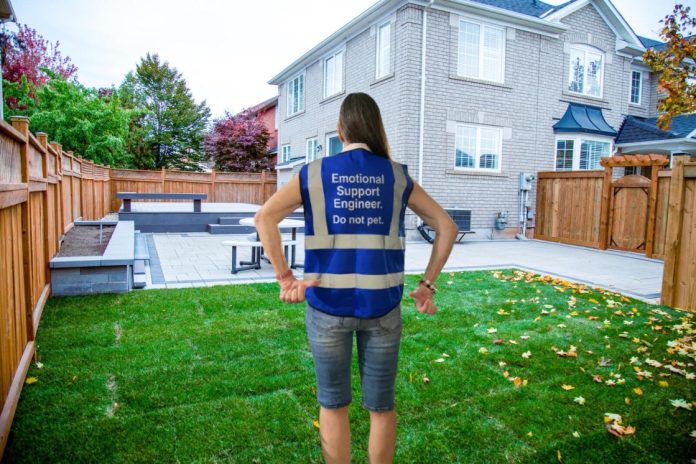
OTTAWA – There is a trend sweeping across Canada where unemployed engineers are finding a new lease on life as full-time “Emotional Support Engineers,” and things are really taking off. In fact, Statistics Canada reported just this morning that the country now has more Emotional Support Engineers than actual engineers currently employed in engineering.
Calgary is the Epicentre of this Movement
The trend reportedly began quietly in Calgary, where unemployed petroleum, software, mechanical, civil, and process engineers were first spotted standing silently beside homeowners at Canadian Tire while muttering things like, “You know, that bracket is massively over-designed,” and “I could build this for half the price.”
Within months, the movement spread nationwide.
“I originally hired Trevor just to help me emotionally process assembling an IKEA bookshelf,” said Ottawa resident Melissa Caron. “But now he follows me around with a clipboard, performs risk assessments on my daily activities, and reassures me that my coffee table has a safety factor of at least 3.2.”
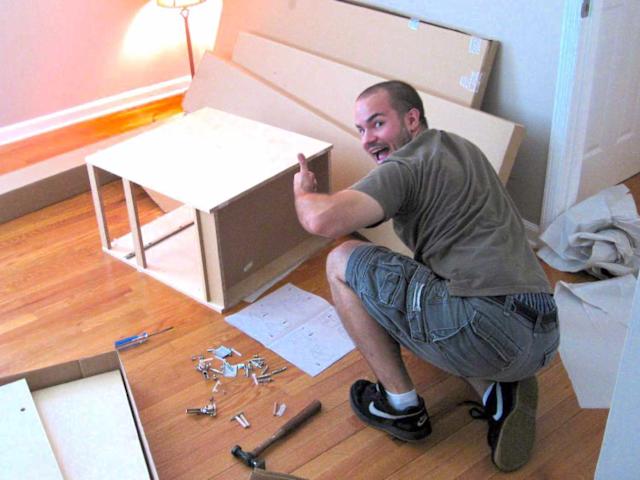
Under the new arrangement, Emotional Support Engineers (ESEs) provide Canadians with comfort, stability, and unnecessary optimization during stressful moments.
Common services include:
- Explaining why your furnace failed using a 47-slide PowerPoint presentation
- Calculating the most efficient dishwasher loading pattern
- Referring to sandwiches as “stacked composite nourishment systems”
- Whispering “that’s not code compliant” during family gatherings
- Creating detailed Gantt charts for weekend camping trips
- Asking “what’s the root cause?” after minor emotional disagreements
Related News: Five things everybody should know about engineers
The federal government has reportedly embraced the program after realizing engineers could be domesticated using only black coffee, mild validation, and access to a spreadsheet.
“We had thousands of highly educated professionals suddenly wandering business parks talking about pressure differentials to strangers,” explained one government official. “This initiative safely reintegrates them into society.”
Many Canadians say the emotional benefits are immediate.

“My Emotional Support Engineer, Darren, reduced my anxiety by 80%,” said Toronto resident Alicia Ng. “Every time I panic about life, he calmly explains that human suffering is just a systems integration issue, and that there’s nothing to worry about.”
Others say the engineers themselves are thriving.
“I finally feel useful again,” said former project engineer Kelly Jensen while labeling storage bins in a suburban garage according to API standards. “Last week I optimized my boyfriend’s pantry flow efficiency by 14%. He cried. I assume from gratitude.”
Related News: Five things everybody should know about engineers, part II
Not all Feedback has Been Positive
Several families reported their engineers becoming agitated after exposure to poorly installed curtain rods, asymmetrical deck stairs, or the phrase “good enough.”
One Vancouver family was forced to re-home their engineer after he attempted to apply Lean Six Sigma principles to Christmas dinner.
“He put my grandmother on a continuous improvement plan,” said family member Rachel Moore. “He referred to mashed potatoes as a ‘legacy starch platform.’”
Meanwhile, corporations are beginning to capitalize on the trend.
A startup in Toronto now offers premium subscription-based engineers capable of advanced emotional support functions including:
- Passive-aggressively reviewing contractor workmanship
- Explaining inflation using fluid dynamics analogies
- Optimizing barbecue heat distribution in real time
- Saying “technically…” before every sentence
The company’s Platinum-tier engineers even include optional field calibration and firmware updates.
Related Reading: Study: Engineers are educated far beyond their intelligence level
In Alberta, several former oil and gas engineers have reportedly formed feral roaming packs near industrial areas, surviving entirely on beef jerky, expired safety training certifications, and memories of $110 WTI.
Wildlife officials advise the public not to approach them directly.
“If encountered, remain calm,” warned authorities. “Slowly place a laminated P&ID diagram on the ground and back away. In most cases, the engineer will become distracted long enough for you to escape.”
New Accessibility Requirements on the Horizon
The program has also triggered a wave of new accessibility legislation across Canada, granting Emotional Support Engineers many of the same protections traditionally reserved for service animals.
Under the proposed federal guidelines, Canadians are now permitted to bring certified Emotional Support Engineers into restaurants, shopping malls, movie theatres, airports, and most public spaces without restriction.
Importantly, Emotional Support Engineers also do not count toward occupancy limits in ticketed venues.
“If a Taylor Swift concert allows 20,000 people, technically you can bring 20,000 people plus one engineer each,” explained a spokesperson from the Ministry of Public Safety and Spreadsheet Management. “The engineers are classified as support infrastructure.”
The policy has already caused chaos at several major sporting events after thousands of engineers arrived carrying laptops, laser pointers, and folding chairs “just in case someone needed troubleshooting.”
At Toronto’s Scotiabank Arena, one Emotional Support Engineer reportedly halted an entire hockey game after noticing “concerning load distribution” in the nacho tray design.
Witnesses say the engineer became visibly distressed after discovering the jalapeños were not symmetrically positioned.
Transportation authorities have also clarified that Emotional Support Engineers are legally permitted to sit at their owner’s feet during flights, provided they remain calm and do not begin explaining the differences between turbulent and laminar fluid flow over an aerofoil surface to nearby passengers during takeoff.
Air Canada has already issued several new compliance policies including:
- Engineers must remain on a leash in crowded terminals
- Retractable leashes are prohibited after multiple engineers wandered off toward mechanical rooms
- Engineers may not be fed exclusively gas-station coffee during flights exceeding four hours
- If startled, avoid sudden movements or saying phrases like “we’ll just eyeball it”
Many owners say leash training has become essential.

“You have to keep a firm grip,” explained Vancouver resident Derek Hall. “If mine spots exposed conduit or a poorly designed retaining wall, he’ll pull hard enough to dislocate your shoulder.”
Pet stores across Canada have begun selling specialized engineering harnesses equipped with calculator holsters, high-visibility vests, and small treat pouches filled with trail mix and USB drives.
Meanwhile Some Businesses Struggle to Adapt
A Starbucks in Calgary recently asked a customer to remove his Emotional Support Engineer after the engineer spent 45 minutes redesigning the café queueing system and conducting a root-cause analysis on a leaking milk dispenser.
“He kept asking where the process bottleneck was,” said one exhausted employee. “Sir, the bottleneck is you.”
At press time, Parliament was reportedly debating whether engineers should be allowed off-leash at Home Depot, though experts warn the species becomes extremely difficult to control near fastener aisles.